Apply the Dialectic diagram to Barr’s chart. Refer to art works.

I made my own dialectic diagram to reflect modernism. I’m finding it very hard to find a way into this exercise: I have flicked through books and magazines, thought and thought, referred to books: in the end the conclusion that I have come to is not that I don’t understand what is required, but really that I don’t think it is a particularly worthwhile exercise.
One of the big problems is that everything is just so Masculine. I am getting a little frustrated by all the “cleverness”. I understand dialectic, and I understand the concept of thesis and antithesis, (how could I not, after all that Plato), but I really do think it is not as simple as being able to use artworks to illustrate the point.
Any discipline will progress, even if it is nothing to do with the arts. That is just the way things are with humans. That’s what they call progress, which isn’t, as we all know, necessarily a good thing. A lot of it, is just to make you buy the next season’s trainers, or a new Dyson. A lot of it, is to be internationally the top-dog: here are some examples of weapons, in not only chronological order, but also deadliness.
- Long Bow
- Cross Bow
- Trebuchet
- Cannon
- Gunpowder
- Blunderbus
- Rifle
- Machine Gun
- Bomb
- A-Bomb
- H-Bomb
Before you mention it, I know this is a list, and not really an example of a dialectic. But if you consider all the nations as Plato and Aristotle, discussing the merits of different ways of killing people, and how to combine previous ways to make new and more inventive ways of killing people, then that would produce a dialectic exchange. In fact: take the long-bow and the cross-bow. The Romans took elements of both to invent the ballista: a kind of mechanized combination of both: and this was the forerunner of the machine-gun. I’ll draw it:

Better and more efficient ways of killing people. It isn’t about dialectic, it’s about being the leader of the pack, or being the next Big Thing. “Progress” will happen without the comparisons. Do we mean “different”, or do we (at least want to) mean “better”?
Let’s take Cubism and Dada, then, and see what we can do. It is possible that something akin to Dada would have emerged independently of anything else. There is an article in Smithsonian Magazine (May 2006) by Paul Trachtman, called “A Brief History of Dada”. In this, Trachtman writes
Dickerman traces Dada’s origins to the Great War (1914-18), which left 10 million dead and some 20 million wounded. “For many intellectuals,” she writes in the National Gallery catalog, “World War I produced a collapse of confidence in the rhetoric—if not the principles—of the culture of rationality that had prevailed in Europe since the Enlightenment.” She goes on to quote Freud, who wrote that no event “confused so many of the clearest intelligences, or so thoroughly debased what is highest.” Dada embraced and parodied that confusion. “Dada wished to replace the logical nonsense of the men of today with an illogical nonsense,” wrote Gabrielle Buffet-Picabia, whose artist husband, Francis Picabia, once tacked a stuffed monkey to a board and called it a portrait of Cézanne.
(Leah Dickermann was a curator at The National Gallery of Art in Washington D.C.)
Dada then: literally “light relief” in the years following the Great War. I love Dada. It literally is nose-thumbing at the Quod Erat Demondstrandum logic of Clever Men. But if you do try and think logically, like the way Clever Men tell us we ought to, it does make a little sense, that elements of Dada can be seen in Cubism: consider this from Douglas Cooper (1971, p15-16):
As soon as the war ended…a reaction against the discipline and fragmentation of Cubism was proclaimed by the Purists, the Dadaists and the Surrealists, all of whom incidentally were able to take advantage of Cubist inventions to achieve quite opposite purposes of their own.

So you could look at a Cubist painting, for example Mondrian’s Female Figure of 1911 and see certain Dada parallels: at first sight it is just a series of rectangular, almost collaged forms, with the suggestion of a face: not a lot to suggest femininity with the rather masculine tones and sharp edges. Someone, apparently Mondrian, is having a laugh. Somewhere, somebody has jumbled everything up. Excellent.
And just look at Duchamp’s incredible “Nude Descending a Staircase (No.2)” of 1912. It is deemed “female”, this figure, by mere virtue of the fact that all nudes would be female. That aside; it is a marvelous painting, full of movement. I remember reading somewhere that this painting was Duchamp’s response to Burne Jones’ “The Golden Stairs” which gives it a certain nose-thumbing flavour, which although 1912 shows precursors to movements like Surrealism and Dada particularly.
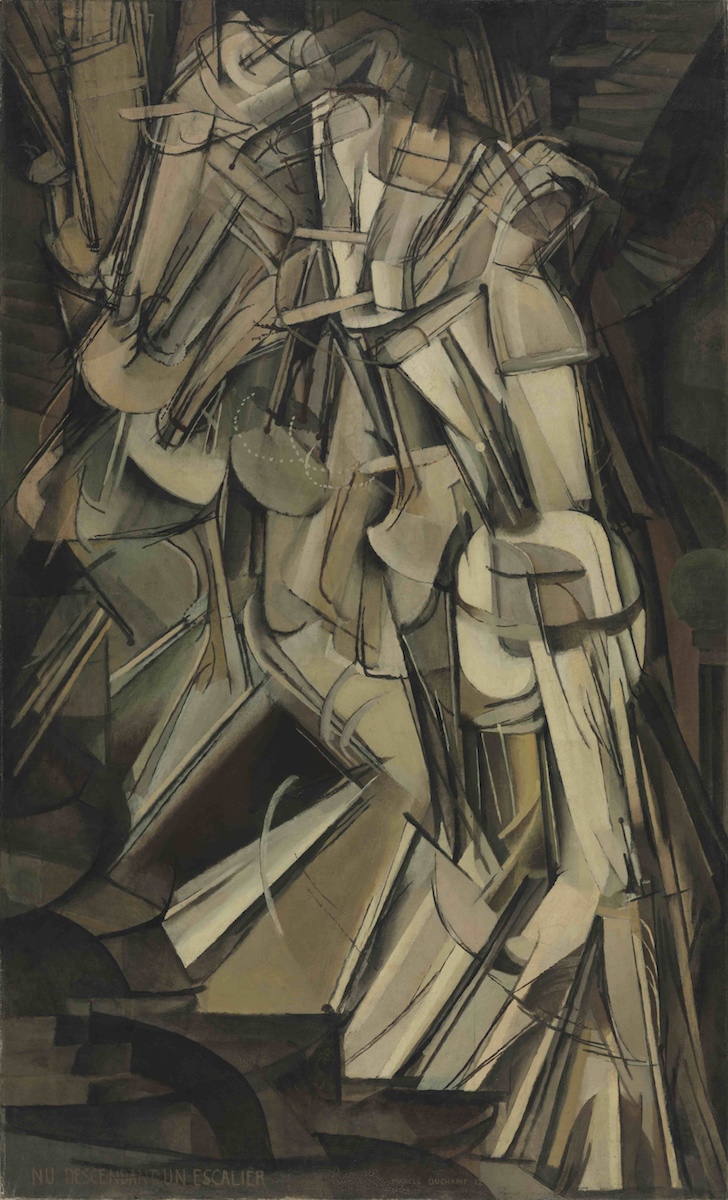
Cubist? Surrealist? Dada? Really you can say there are elements of all three. Also a Machine Aesthetic, Futurism, Constructivism. It’s not really easy to say where one movement ends and another begins, unless somebody writes and publishes a manifesto, and puts an often made-up word on the cover: a bit like Fluxus. I really do think that as new ways of working emerged, figures such as Breton would write a “manifesto” so that they could then be seen as The Next Big Thing in the art world, and also of course, Terribly Clever. Which leads me back to not thesis/synthesis, but rather “my interpretation is better and cleverer than yours.” (Have any of these twentieth century manifestos been penned by Terribly Clever Women? Of course not. Although I better check that…)
Cooper says, in a brilliant reflection of the whole thesis-antithesis-synthesis thing: “The result of (the spread of cubism)… was to encourage artists everywhere to look long at cubism and think about what it had to offer. And this opening of a debate inevitably led to restless experimentation. Cubism could surely be improved on or put to other uses, they seem to have decided. And so… we find the Cubism of Braque and Picasso- which to some artists seemed cold, colourless, static, reasonable or convention-bound; providing the impetus for new movements which assumed a wholly different character: Orphism, Futurism, Cubo-Futurism, Rayonnism, Vorticism, Suprematism, Dadaism and ultimately Purism” (1971 p102). I think it’s fair to say that Dada involves a certain sense of subversive mockery: Cubism certainly looks at form in a less-than-conventional manner. So while Mondrian wasn’t really “having a laugh” with his compositional forms, Dada was.
Let’s look at Cooper’s 1971 conclusions. He says that Cubism was the outcome of a conviction that established methods and conventions were outdated: and false. This takes us back to that Platonic view that painting just presented us with falsehoods: with visual tricks and devices to fool our eyes. He quotes (but doesn’t source) Braque: Cubism’s aim was “not to try and reconstitute an anecdotal fact, but to constitute a pictoral fact” (p263).

This was reinforced with Picasso’s first uses of collage: in his 1912 “Still Life with Chair” he makes use of a scrap of fabric, printed with actual chair caning. It is a piece of ready-made, but it isn’t: not quite, because it isn’t real chair-caning. It is a Platonic comment: a paradox of real, fake, simulacrum, copy, representation, difference. And then there is that “Jou”: most of the french word for “play”. That’s a bit Dada, n’est ce pas? Picasso has even “framed” the piece with a length of what looks like upholstering trim, the type you would find on a chair.
In common with Cubism, Dada made good use of collage. But if Cubism used collage to challenge representations of the “real” then Dada used it to critique the “increasingly mechanised, violent world”. Rubin (1968, p42, quoted at MoMA.org) says that in their use of collage, Dada artists “could attack the bourgeoisie with distortions of its own communications imagery. The man on the street could be shocked to see the components of a familiar letter of his newspapers and posters running amuck.” To me, that is a direct link to that Picasso cane chair: whilst not mocking anything violent, it kind of is making comment on the mechanised, regular appearance of that woven cane, isn’t it? And the word “Jou”: which must be from I think a newspaper title, but suggests a bit of mockery in that it implies the French for “play” or “game”. It isn’t real: it could almost be photographic, it isn’t painted, it isn’t anything. But it is.

Compare that caned chair of Picasso’s to Schwitters’ “Mertz” pictures. Like that “Jou”, the word “Mertz” is a fragment: from the longer word “Kommertz”. Schwitters had found the longer word on a torn advert whilst walking around Hannover. To say that this may be the point where Cubism “meets” Dadaism may be pushing it a bit, but I think it might be. Dada was kind of the antithesis of everything, but you can sense the dialectic between the two movements. Although I don’t think he was ever officially embraced by the movement, Schwitters’ work had all its essence. Galenson (2013) quotes the Dada poet Tristan Tzara: Schwitters was “one of those personalities whose inner structure was always Dada by nature. He would still have been Dada even if the Dada call had not been sounded” The Mertz pictures have much in common with that Picasso: collage, overlaid media, things on top of other things, of other things.
I think of thesis and antithesis as a bit like the forging of a new element: throw two balls of “stuff” at each other from a distance and you will get some debris, comprising the bits that didn’t “go”, and another ball of “stuff”. There’s your synthesis. So what is the synthesis of Dada and Cubism? According to Barr, it would be Surrealism: the love-child of the first two, I guess. Let’s start with André Breton.
Breton was a poet, and also an orderly in a hospital caring for shell-shock victims of the great war. It was as a witness to all this trauma that lead him to examine the subconscious, particularly the effect of experiencing traumatic events that there was no way of preparing for. An encounter with the Dadaist Jacques Vaché also had a profound effect: “the idea of life as a series of unpredictable and uncontrollable shocks was enacted by Breton and Vaché in a type of movie-going in which they entered and exited from screenings in rapid succession and without any regard for the program, thereby producing a random collage of visual and narrative experiences wholly out of their control” (Foster et al 2011 p196).
What an interesting thing to do. A bit like pulling novel after novel off the shelf and taking random sentences, stringing them together to see what kind of narrative you get; as a kind of randomly select automatic writing. I might try that. Multiple views: which relates to Cubism, and utter and meaningless nonsense, which is pure Dada. Breton went on to combine this “openness to whatever might happen” (ibid) with the irrational narrative of dreams and their interpretation. Interestingly Breton bought many Picasso’s from war-sequestered government stock, and claimed that Picasso was an unwitting Surrealist.

1924 from Foster et al 2011 p197
The most obvious bit of DNA which has “Synthed” from the two is collage: always a mainstay of Surrealism. Take Ernst’s “Two Children Menaced by a Nightingale” of 1924, which has definite echoes of Schwitters’ Mertz pictures, and of Picasso’s cane chair, with the “ready made” twigs/gate. What marks it out for me, as being Surreallist, is the ready-made frame and the little collaged elements. It has an incongruous child-like quality, with all that sky, and the naive structure which could be shed, or house: is that a man holding a baby? Is he somehow responsible for the fright caused and is trying to escape by pulling that blue knob? The little knob itself looks like it could reveal another dimension to this dream-like picture: open the canvas by pulling the knob and there might be another dream underneath (I don’t think there is. That is what it suggests to me). So there you have all the Freudian stuff as well: a father figure on the roof? Does the flying bird represent freedom, and why is one of the girls brandishing a whopping big knife at it? Is that a phallic thing?
Here’s another by Belgian Surrealist René Magritte, a small water-colour and collaged piece, Sans Titre, of 1925-6. All those holes and phallic shapes: what does it mean? It’s called “Without Title”. It all suggests to me, that Magritte was “experimenting” (or could we be bold, and say, he was messing about in his studio? Like many of us do, when we are stuck indoors on a rainy Sunday afternoon?)

Nominally, it is pigeon-holed into the Surrealist slot. But it is a bit daft: a bed-post popping up over the horizon, it has collage, and flatness: it’s not really anecdotal in the sense that Braque referred to: there are no tricks. It is, in a cubist sense, pictoral.
To conclude, I think what I have been trying to say is that yes: we can pigeon-hole things, and call them Dada or Cubist or Surreal. We can see how one thing leads to another, and turns into something else. Dialectic all just seems a bit obvious, but in a huge way that I am finding hard to articulate. Much of this comes from my female viewpoint, I think. Most of the artists we study, and the theory that goes with the art: it’s all by men. The UVC manual has been written by a man. I kind of wish they had found a woman to write it. I’ve been through the entire manual and counted the examples given: 61 are by male artists and 7 are by female artists. Even in the final section: which concerns contemporary art, there are 9 examples by men and just two by women.
I was bemoaning all the male cleverness to my husband yesterday, who said to me “don’t forget that you wanted to do this course because you had got bored with producing pretty pictures”. He’s right, I did say that. I went to one of the commercial galleries here in Brighton, and had a look at what was on offer: lino-print after lino-print of flowers, landscapes, the pier, beach huts, animals. All by women. They are all very pretty. There was one large sea-scape in pride of place, all dark blues and greys and drama and noise. This was by a man. The female place in art still seems today to be very much as a hobbyist, or life-model (we get very excited at Life-drawing, on the rare occasion that we get a male model). I am taking this course, to broaden my horizons, and I am loving it. I just wish the horizon wasn’t so very Male. However, writing this exercise has culminated in some interesting sketch-book pages: apologies to Alfred Barr, Clement Greenberg and Grayson Perry, not to mention Manet.
Bibliography
Cooper, D (1971) The Cubist Epoch Phaidon, London
Foster et al (2011) Art Since 1900 Thames and Hudson, London
Rubin, W. (1968) Dada, Surrealism, and Their Heritage (The Museum of Modern Art, New York)
Fischer, H (1972) A Journey into the Universe of Art (Curwen Press, London).
https://www.dadart.com/dadaism/dada/038-Schwitters.html accessed 1st Feb 2020
https://www.khanacademy.org/humanities/art-1010/wwi-dada/dada1/a/marcel-duchamp-nude-descending-a-staircase-no-2 accessed 2nd Feb 2020
https://www.pablopicasso.org/still-life-with-chair-caning.jsp accessed Feb 1st 2020
https://www.moma.org/learn/moma_learning/themes/dada/chance-creations-collage-photomontage-and-assemblage/ accessed 1st Feb 2020
https://www.smithsonianmag.com/arts-culture/dada-115169154/ accessed Feb 1st 2020
 Understanding Visual Culture with the Open College of the Arts