Feedback took place in the form of a written report.
I took my tutor’s advice and revisited the assignment, trimming the history a little and using another example of Nam June Paik to extend the point about participation versus voyeurism. I also trimmed out the section about box-office sales. It was suggested that I look at Warhol’s “Empire” which I have done, but because my report was already lengthy I have not included mention of it. It was suggested that using “Empire” could show the bridge between installation and cinema, but I felt that the report would then have become too long. The course asks for 1000 words (which already seemed a little brief, in my opinion). I have tried to extend Mulvey’s argument a little.
I did find this particular assignment rather tough: mostly because I have never really considered a precis of this particular subject. I did make a trip to Tate Modern to see the Nam June Paik exhibition with the express intention of gaining information for the essay, and am really glad that I did, I loved his work.
In re-working the essay I feel it does flow a little better and has more academic rigor with the recommended sections trimmed and re-worked. It was pointed out that I had missed a couple of references, I think these were Danto and the featured picture, which I have rectified.
I found the Serra sections very interesting, and could see clear links between his physical and video work.
I have revisited certain overly “chatty” sections of the exercises in the blog and formalised them a little, although I do feel slightly confused by this as earlier on in the course it was suggested that this “chatty” style was good and something to be nurtured. In my opinion a blog is a less formal platform than an essay, but I have formalised it all the same.
I think my frustrations with the course as a whole are clear: in places the grammar is incorrect, and there are both factual and pictorial errors with artists and dates. It reads as if it was written in a hurry, and not peer-reviewed. There is also a definite bias towards white male artists: which is probably more to do with the chronology of art rather than its actual players: even so it would have been good to see some more positive additions of female or black artists. Having challenged this in the course of my blog, I have discovered Perle Fine, Faith Ringgold (at the suggestion of my tutor) and W. Barns-Graham, and also enjoyed researching Fred Wilson (a rare inclusion of a black artist).
My frustrations with the omni-present Alfred Barr have been made clear in the course of my blog, but I hope that I have dealt with these with some visceral sketch book responses.
On the whole, once I got past these general frustrations with the course content, I thoroughly enjoyed the research and reading and hope that it will impact on my own practical work in the future. I have moved onto part 2 now, with Drawing, a Personal Approach, and when I have completed this, I intend to take on UVC part 2 as I understand from the course sample that it contains a blend of practical and theoretical work. I feel it would have been beneficial to have a little prescriptive practical work in UVC part 1 but hopefully I have managed to include some practical work alongside all the theory.
For Clement Greenberg, “art was the polar opposite of mass-produced ‘kitsch’ or popular visual culture (Mirzoeff 2009, p180). This essay will examine both cinema and video installation in terms of popular culture and art, and will use the work of Bruce Nauman to highlight the popular differences in experience.
Fig 1 Eadweard Muybridge’s photographic sequences of horses, 1878. From Rush 1999, p13.
Eadweard Muybridge’s 1878 sequence of a running horse was probably the first example of anything resembling a moving image. he used a series of triggered cameras, the result was the first sequence to show the actual stages of motion (fig 1). This new way of seeing: the apparent ability to harness temporality, was instrumental for the experimental nature of twentieth century art, which had practitioners “bursting from the shells of painting and sculpture in a huge variety of ways and incorporating new materials into their work… (including) uses of new technological media to render meaning and new ideas of time and space.” (Rush 1999, p7). The effect of the moving image on the canvas is clear, if one looks at Duchamp’s “Nude Descending a Staircase No. 2” (1912) and Giacomo Balla’s “Dynamism of a Dog on a Leash” of the same year (figs 2 and 3).
Fig 2 Marcel Duchamp Nude Descending a Staircase No.2 1912. From Foster et al p125.Fig 3 Giacomo Balla, Dynamism of a Dog on a Leash 1912. From Rush 1999 p1.
Rush reminds us that Duchamp, predictably, had a huge role in harnessing the moving image in art: his “radical shift of emphasis from object to concept allowed for multiple methods to be introduced to a redefined artistic enterprise” (1999, p21). This approach is particularly applicable to the work of Bruce Nauman, who has worked with a range of methods since the 1960’s.
In 1965 Pierre Bourdieu commented on the public’s perception of what we could now broadly refer to as “the arts”. He suggested that popular culture is “vulgar”, echoing Clement Greenberg’s comments on Kitsch- and refers to theatre, painting, sculpture, literature and classical music as “the fully consecrated arts”. According to Bourdieu these have “cultural legitimacy”. If we assume then that anything which exists in a national gallery such as Tate Modern has cultural legitimacy, then it exists for what Bourdieu terms “scholarly consumption”. This, in turn, requires “erudite knowledge” as opposed to popular culture which exists for “simple consumers” (Bourdieu 1999 p176-77). This echoes Arthur C Danto’s “Works of Art and Mere Real Things” (pcnw.org, accessed March 2020) which questions the definition of art in that something becomes art when the artist, or The Establishment, declares it to be so, thus crediting it with cultural legitimacy.
Laura Mulvey comments that the cinema offers a number of possible pleasures; one being Scopophilia, or the pleasure of looking (1999, p381). There is a sense of voyeurism: “the extreme contrast between the darkness in the auditorium (which also isolates the spectators from one another) and the brilliance of the shifting patterns of light and shade on screen helps to promote the illusion of voyeuristic separation. Although the film is really being shown, is there to be seen, conditions of screening and narrative convention give the spectator an illusion of looking in on a private world” (1999, p382). There is a separateness, then, a sense of watching, unobserved in the shadows of the auditorium of a cinema, rather than of being invited to share in a process of making.
Fig 4 Nam June Paik’s Uncle robot, with technological components and screens showing video. My photo, Tate Modern, January 2020.
Thus these cinematic conventions are not necessarily present in video installation. There is a lesser sense of “separateness”; people can come and go during loops of a video and sometimes, with Nam June Paik’s work for example, (fig 4 ) the installations are sculptural, negating the need for a separate, darkened room. Paik’s work is often interactive: as well as being observer, one experiences the work by pressing buttons, or just by moving in the exhibition space. In One Candle (Candle Projection) of 1989, a CCTV camera records a single candle flame, which flickers and moves when visitors walk past (fig 5).
Fig 5 Nam June Paik, One Candle (Candle Projection) 1989. My photo, Tate Modern, January 2020.
The temporal aspect is different, the cinematic film is a prescribed nugget of time whilst the installation time-scale is a shifting one. The observer can cast a passing glance, stay for an entire loop, or watch again and again, or keep on pressing buttons.
Akin to this sense of different experience is the concept of “The Gaze”. Margaret Olin points out that “gaze” can be seen as a sub-heading of the category of “Spectatorship”:
“Spectatorship covers a complex of terms with interchangeable meanings but different connotations while scrutinizing suggests the involvement of intellect” (2003, p318-9).
The crucial difference for installations then, is one of involvement, of scrutiny over spectatorship. Bruce Nauman embraced the notion that all activities undertaken by artists in their studios are ipso facto works of art, thus art is re-defined as an activity for scrutiny rather than a product to be watched, or consumed. This places him firmly in Sol Lewitt’s 1967 manifesto for a new conceptual approach (fig 6) in which physical materials could be dispensed with (Harrison 2009, p 301).
Fig 6 Sol Lewitt’s “Sentences on Conceptual Art” 1967. Image from moma.org used for educational purposes.
Art becomes activity rather than product, a concept which resulted in Nauman’s early films of the 1960’s which feature him recording his movements in the studio. In these films “The viewer is invited into a voyeuristic encounter with the artist in his workplace as he defines the physical space of the studio with his body” (Rush 1999 p101). This is not a separated, anonymous voyeurism in Mulvey’s sense; Nauman is inviting us to watch him as he shares his processes. The films were the result of his realisation that he spent most of his time pacing up and down in his studio, so he recorded his physical activity: “walking, dancing, playing the violin, putting on make-up, making faces” (Gale 2016, p248).
These are incredibly intimate insights into the artist’s space, both physical and mental. “Wall Floor Positions” (1969) provides the observer with an hour of Nauman literally throwing shapes: he slaps the floor and walls, in contortions which are reminiscent of the children’s game “Twister”, holding each position for a few seconds before assuming the next (fig 7). He seems involved in some kind of inner conflict; each pose is like a sculpture or drawing of the contorted human form. This piece is personal, exploratory, and never really intended for a gallery let alone the cinema; although it would not be out of place in an exhibition concerning the conflict of the human form, amongst pieces by Hepworth and Moore, with Epstein’s “Jacob and the Angel”. Similarly, “Walking in an Exaggerated Manner Around the Perimeter of a Square” gives the observer 10 minutes of Nauman walking around a square marked out on the studio floor: he slowly steps, dips a hip, steps and dips a hip… the effect is hypnotic. The actions are very deliberate, meditative; one really watches the shapes Nauman’s torso makes; dressed in a white t-shirt against the grainy background of the 16mm film.
Fig 7 A still from Nauman’s “Floor Wall Positions”. From artsy.net and used for educational purposes.
The ultimate manifestation of this concept was Nauman’s 7-screen installation of 2001: “MAPPING THE STUDIO III with color shift, flip, flop, & flip/flop (Fat Chance John Cage)”. In this major piece (fig 8 and featured image) Nauman used footage from his New Mexico studio, this time submitted to image and colour manipulation. Once again he used events and movement from the studio as the basis of the piece: frustrated with a lack of inspiration following the completion of a major commission, his eye was drawn to the studio cat, which was unable to keep up with an influx of mice. As before, taking “whatever-happens-in-the-studio” as an intrinsic part of his practice, he set up cameras to record the movements of the mice; and the cat (which never quite manages to catch a mouse).
MAPPING THE STUDIO II with color shift, flip, flop, & flip/flop (Fat Chance John Cage) 2001 Bruce Nauman born 1941 Purchased jointly by Tate, London with funds provided by the American Fund for the Tate Gallery; Centre Pompidou, Mus?e national d’art moderne, Paris with the support of Mr and Mrs William S. Fisher Family Foundation and the Georges Pompidou Culture Foundation; and Kunstmuseum Basel, 2004 http://www.tate.org.uk/art/work/T11893 used for educational purposes.
Each of the seven films is looped concurrently in the same exhibition space. Even though an observer may at any point assume that nothing is occurring at the point in which they entered the space, Nauman points out that there is always something to see: “You begin to (notice) smaller and smaller incidents. At first I was looking for the cat and the mouse, and then I started to listen to the flies buzzing round or to see the beautiful patterns that the moths make as they fly around in front of the camera. There was a lot more going on than I was anticipating” (tate.org).
This level of scrutiny takes Nauman’s work completely out and away from a cinematic experience- the viewer becomes almost forensically involved in the activity on the seven screens. The observers become part of the installations, like detectives looking for clues on crime-scene CCTV. Mulvey’s voyeurism is absent: watching becomes less scopophilic and more of an essential task: one feels afraid to look away in case something is missed.
Film making, whether cinematic or artistic, is a process of acquisition and reproduction. Ultimately this is the only similarity. The introduction of portable technology in the 1960s made instant playback possible, making the use of video more accessible to artists. As Farthing suggests (2010 p 528) “video art was unconstrained, it could be without actors, audio and plot, and be of unspecified length.” The artist could be director, actor, producer and editor rolled into one. Bruce Nauman is just one artist using this medium to its’ full advantage- it was relatively cheap, easy to master and became ubiquitous from the late 1960’s in offering artists new ways to display methods and processes. The cinematic experience embraces The Object, or the movie itself (along with the parallel merchandise and music industries) whilst the installation experience is very much, as Duchamp originally showed us, a conceptual one.
Bibliography
Bourdieu, P (1999) The Social Definition of Photographyin Evans, J & Hall, S Visual Culture, the ReaderSage, London pp 162-180.
Danto, A (1981) Works of Art and Mere Real Things in The Transfiguration of the Commonplace accessed at http://pcnw.org/files/Danto.pdf accessed 4 March 2020.
Foster et al (2011) Art Since 1900 Thames & Hudson, London.
Gale, M (2016) Tate Modern, The HandbookTate Publishing, London.
Harrison, C (2009) An Introduction to Art Yale University Press, London.
Mirzoeff, N (2009) An Introduction to Visual Culture Routledge, London.
Mulvey, L (1999) Visual Pleasure and Narrative Cinemain Evans, J & Hall, S Visual Culture, The ReaderSage, London pp 381-389.
Olin, M (2003) Gaze in Nelson, RS & Shiff, R (eds) Critical Terms for Art HistoryChicago University Press, Chicago pp 318-329.
Rush, M (1999) New Media in Late 20th Century ArtThames & Hudson, London.
For Clement Greenberg, “art was the polar opposite of mass-produced ‘kitsch’ or popular visual culture” (Mirzoeff 2009 p.180). This essay will make a brief study into the history of film before examining the work of Bruce Nauman to highlight the polar differences in experience.
Fig 1 Eadweard Muybridge’s photographic sequences of horses, 1878. From Rush 1999 p.13
Eadweard Muybridge’s 1878 sequence of a running horse was probably the first example of anything resembling a moving image. He used a series of triggered cameras; the result was the first sequence to show the actual stages of motion (fig 1). This new way of seeing: the apparent ability to actually harness temporality, was instrumental for the experimental nature of twentieth century art, which had practitioners “bursting from the shells of painting and sculpture in a huge variety of ways and incorporating new materials into their work…(including) uses of new technological media to render meaning and new ideas of time and space” (Rush 1999 p7). The effect of the moving image on the canvas is clear, if one looks at Duchamp’s “Nude descending a Staircase No.2” (1912) and Giacomo Bella’s charming “Dynamism of a Dog on a Leash” of the same year (figs 2 and 3).
Fig 2 Marcel Duchamp’s 1912 Nude Descending a Staircase no.2 . From Foster et al p.125Fig 3 Giacomo Balla 1912 Dynamism of a Dog on a Leash From Rush 1999 p.1
Cinema itself emerged in America, and was taken up by the Frenchman George Melies: his film from 1902, “A Trip To The Moon” looking “very much like an out-take from a 1950’s science fiction film” (Rush 1999 p. 7) with a rocket landing in the Moon’s eye (fig 4). The Avant Garde embraced cinema, but it was not until the 1920’s that it took off as a separate industry. This could be seen as the “bifurcation point”, or the point at which cinema and art followed different directions. Rush (1999) reminds us that Duchamp, predictably, had a huge role in harnessing the moving image in art: his “radical shift of emphasis from object to concept allowed for multiple methods to be introduced to a redefined artistic enterprise” (p.21). This approach is particularly applicable to the work of Bruce Nauman, who has worked with a range of methods since the 1960’s.
Fig 4 A still from George Melies’ film A Trip to the Moon, from http://www.vox.com used for educational purposes.
The ultimate difference between cinema and video installations is economic. According to billboard.com, 2019 saw Global box-office revenue hit over $42 billion, with ticket sales of more than $11 billion in North America alone. It is a huge money-spinner, with huge associated industries hanging on to its apron strings in the form of sponsorship, toy manufacturing, the music industry with endless sound-tracks, clothing… not to mention all the affiliated food and drink franchises situated within cinema complexes. The massive amount of income generated by all this, is evidence of the huge popularity of cinema. Video installations and the use of film by artists is an entirely separate enterprise.
In 1965 Pierre Bourdieu commented on the public’s perception of what we could now broadly refer to as “the arts”. He suggests that popular culture is “vulgar”, echoing Clement Greenberg’s comments on Kitsch- and refers to theatre, painting, sculpture, literature and classical music as “the fully consecrated arts”. According to Bourdieu these have “cultural legitimacy”. If we assume then that anything which exists in a national art gallery, for example Tate Modern, has cultural legitimacy; then it exists for what Bourdieu terms “scholarly consumption”. This, in turn, requires “erudite knowledge” as opposed to popular culture which exists for “simple consumers” (Evans, J & Hall, S p. 176-177). This echoes Arthur C Danto’s “Works of Art and Mere Things” (visited in exercise 5:0) which questions the definition of art: in that, something becomes art when somebody: the artist, or The Establishment: declares it to be so and thus credits it with cultural legitimacy.
Laura Mulvey comments that the cinema offers a number of possible pleasures: one being scopophilia, or the pleasure of looking (Evans & Hall 1999 p.381). She also comments that mainstream cinema tends to focus attention on the human form, that its narrative is anthropomorphic, it tells stories about the human condition. This is the appeal of cinema: coupled with the sense of voyeurism: “the extreme contrast between the darkness in the auditorium (which also isolates the spectators from one another) and the brilliance of the shifting patterns of light and shade on the screen helps to promote the illusion of voyeuristic separation. Although the film is really being shown, is there to be seen, conditions of screening and narrative conventions give the spectator an illusion of looking in on a private world” (ibid p.382).
These conventions are not necessarily present in gallery installations. The feeling of “seperateness” is absent: people come and go during loops of the video and sometimes, with the work of Nam June Paik for instance (fig 5), the installations have a sculptural effect which negates the need for a darkened room, or are interactive. The temporal aspect is different: the cinematic film is a prescribed nugget of time, whilst the installation time-scale is a shifting one: the viewer can cast a passing glance, stay for one entire loop, or watch the scene again and again. Akin to this, is the concept of “the gaze”. Margaret Olin (2003, p318-19) points out that “Gaze” can be seen as a sub-heading of the category of “spectatorship”:
“‘Spectatorship covers a complex of terms with interchangeable meanings but different connotations, while ‘scrutinizing’ suggests the involvement of intellect.”
Fig 5 Nam June Paik’s “Uncle” robot, with technological components and screens showing video. My photo, from the exhibition at Tate Modern, February 2020
The crucial difference for artists then, is one of “scrutiny” over “spectatorship”. Nauman himself embraced the notion that all activities undertaken by artists in their studios are ipso facto works of art, thus art is re-defined as an activity to be scrutinized, rather than a product to be “watched”, or consumed. This places him firmly in Sol Lewitt’s 1967 guidelines for a new conceptual approach (fig 6), in which physical materials could be dispensed with (Harrison 2009 p.301). Art becomes an activity rather than a product, a concept which resulted in Nauman’s early films of the 1960’s which feature him recording his movements in his studio. In these films, “the viewer is invited into a voyeuristic encounter with the artist in his workspace as he defines the physical space of his studio with his body” (Rush 1999 p 101). The films were the result of Nauman’s realisation that he spent most of his time pacing up and down in his studio, so he recorded his physical activity: “walking, dancing, playing the violin, putting on make-up, making faces” (Gale (ed) 2016 p248).
Fig 6 Sol Lewitt’s “Sentences on Conceptual Art”. image from Moma.org used for educational purposes
Although Rush describes these videos as “voyeuristic” they are also incredibly intimate insights into the artist’s space, both physical and mental. “Wall Floor Positions” (1969) provides the viewer of an hour of Nauman literally throwing shapes: he slaps the floor and walls, in contortions reminiscent of the children’s game “Twister”, holding each position for a few seconds before assuming the next. He seems involved in some kind of inner conflict; each pose is like a sculpture or drawing of the contorted human form. This piece is personal, exploratory, and never really intended for a gallery let alone the cinema, although it would not be out of place in an exhibition concerning the human form, amongst pieces by Hepworth or Moore, with Epstein’s “Jacob and the Angel”. Similarly, “Walking in an Exaggerated Manner Around the Perimeter of a Square” presents 10 minutes of Nauman walking around a square marked out on the studio floor: he very slowly steps, drops a hip, steps and drops a hip… the effect is hypnotic. The actions are very deliberate, meditative; one really watches the shapes Nauman’s torso make: dressed in a white t-shirt against the grainy background of the 16mm film.
Fig 7 A still from Nauman’s “Wall Floor Positions”., taken from http://www.artsy.net and used for educational purposes.
The ultimate manifestation of this concept was Nauman’s 7-screen installation of 2001: “MAPPING THE STUDIO II with color shift, flip, flop,& flip/flop (Fat Chance John Cage).” In this major piece Nauman used footage from his New Mexico studio, this time submitted to image and colour manipulation. Once again he used events and movement from the studio as the basis of the piece: frustrated with a lack of inspiration following the completion of a major commission his eye was drawn to the studio cat, which was unable to keep up with a large influx of mice. As before, taking “whatever-happens-in-the-studio” as an intrinsic part of his practice, he set up cameras to record the movements of the mice: and the cat (which never manages to catch a mouse on film).
Fig 8 MAPPING THE STUDIO II with color shift, flip, flop, & flip/flop (Fat Chance John Cage) 2001 Bruce Nauman born 1941 Purchased jointly by Tate, London with funds provided by the American Fund for the Tate Gallery; Centre Pompidou, Mus?e national d’art moderne, Paris with the support of Mr and Mrs William S. Fisher Family Foundation and the Georges Pompidou Culture Foundation; and Kunstmuseum Basel, 2004 http://www.tate.org.uk/art/work/T11893 used for educational purposes.
Each of the 7 films is looped concurrently in the same installation space. Even though a viewer may at any point assume that nothing is occurring at the point in which they entered the space, Nauman points out that there is always something to see: “You begin to [notice] smaller and smaller incidents. At first I was looking for the cat and the mouse and then I started to listen to the flies buzzing round or to see the beautiful patterns that the moths make as they fly around in front of the camera. There was a lot more going on than I was anticipating”(http://www2.tate.org.uk/nauman/work_3.htm).
Film-making, whether cinematic or artistic; is a process of acquisition and reproduction. Ultimately, this is the only similarity. However the introduction of portable technology in the 1960s made instant playback possible, making the use of film more accessible to artists. As Farthing points out (2010 p 528) “video art was unconstrained, it could be without actors, audio and plot, and be of unspecified length”: the artist was director, actor, producer and editor rolled into one. Bruce Nauman is just one artist using this medium to its full advantage: it was relatively cheap, easy to master and became ubiquitous from the late 1960’s in offering artists new ways to display methods and processes. The cinematic experience embraces “the object”, or the movie itself, whilst the installation experience is very much, as Duchamp originally showed us, a conceptual one.
Bibliography
Bourdieu, P (writing in 1965) The Social Definition of Photography in Evans, J & Hall, S (eds, 1999) Visual Culture, The Reader pp 162-180 Sage, London
Danto, A C Works of Art and Mere Things in The Transfiguration of the Commonplace accessed at http://pcnw.org/files/Danto.pdf 9 May 2020
Farthing, S (2010) Art; TheWhole Story Thames & Hudson, London
Foster et al (2011) Art Since 1900Thames & Hudson, London
Gale, M (ed, 2016) Tate Modern: The HandbookTate Publishing, London
Harrison, C (2009) An Introduction to Art Yale University Press, London
Mirzoeff, N (2009) An Introduction to Visual CultureRoutledge London
Mulvey, L (writing in 1973)Visual Pleasure and Narrative Cinema in Evans, J & Hall, S (eds, 1999) Visual Culture, the Reader pp. 381-389 Sage, London.
Olin, M. (2003) Gaze in Nelson, RS and Shiff, R (eds, 2003) Critical Terms for Art History Chicago University Press, Chicago.
Rush, M (1999) New Media in Late 20th Century Art Thames & Hudson, London
Wilson, S & Lack, J (2016) Tate Guide to Modern Art TermsTate Publishing, London
Familiarise yourself with Serra’s work and say why you think he made these films.
Serra is best known for his architectural sculpture, particularly site specific work which, according to MoMA, emphasise “materiality and an engagement between the viewer, the site, and the work” (moma.org).
The Serra pieces are concerned with, it seems, the contrast between their substance and the very air which exists a micron away. They share space with a void; tripping it up, bending, tilting into space, or solidly and squarely intruding upon it (figs 1 and 2). Sometimes, as with the infamous Tilted Arc (1981), they intrude upon public places, altering and bending our perceptions of them, interrupting the space and slicing into the familiar. Tilted Arc not only changed the view of New York’s Federal Plaza, but it undoubtedly would have altered the way sound carried across the space too.
Fig 1 Richard Serra Casting 1969 (lead) from Foster (2011) p 580Fig 2 Richard Serra One Ton Prop (House of Cards) 1969 (lead) from Foster (2011) p 580
Although Tilted Arc came later than the work we are looking at, it was a product of the earlier work. Hal Foster compares him to Robert Morris, who wrote of his own process work of the late 1960’s, “the discrete object (is) dissolved into the sculptural field which is experienced in time” (2011, p580). 1969’s Casting (fig 1) was one of the results of the Process-generated experiment in which Serra generated a list of verbs (rolling, creasing, folding…) which in turn generated a series of works, mainly in lead- possibly due to its malleable properties.
Fig 3 Frames from Serra’s 1968 film “Hand Catching Lead”. From artic.edu used for educational purposes.
According to lightcone.org (an archive of experimental film) Serra was originally asked to document the making of his sculpture House of Cards (fig 2: although possibly an earlier version, given the date) “but decided that a traditional documentary would not be able to capture the creative process. Instead, the work is a “filmic analogy” of the construction of the sculpture: his catching of the pieces of lead is a more refined representation of months spent lugging blocks of lead around his attic” (ibid). A process capturing the process, then. Watching the film, you get a sense of repeated action, successes and failures, hard and soft, effort and gain; the same kind of intrusive, visceral interruptions which come from his later sculptural works in steel.
I wanted to do something where I could study my own sentiments and experiences and I found that I could do that in relation to making things… it was a place I could always go to, that I could concentrate and deal with problems that I thought were of interest to me, and if I was clear enough about what it was that I was probing and stayed with the premis of what I was probing, it was possible that it could also be clear to someone else…. I think that one of the things art does, is it asks you to perceive what it is on its own level, it can be reassuring, it could be exactly the opposite, it could agitate you, it could be something you dismiss, it could be something that engages you, it could be something you recall, it could be something that leads to things that have nothing to do with what you’re looking at.
This lovely transcript echoes engagement, it echoes materiality and the relationships between artist and viewer, and time and space. All this is palpable in both the presence- the interplay between architecture, space and time- of Serra’s sculptural work and also in the films that he made.
Serra found the medium of film “intimidating” (lightcone.org) and “Hand Catching Lead” was his first foray. Watching it, one gets the sense that it came as a kind of after-thought, almost as part of a cleaning-up process, in the same way one might make some mono-prints with left over paint. There are, according to Lilian Harberer two other films made at the same time, featuring Serra and also his friend, the composer Philip Glass, featuring hands tied, and lastly, two pairs of hands sweeping up steel filings and depositing them into a heap. Given Serra’s feelings about film, that these were his first examples, and also the presence of his friend (did he suggest the making of a film?) I would say that in this example, what we see, is two creative chums experimenting with a new medium. Harberer quotes Rosalind Krauss talking about these films:
“Three things conspire then, to create the peculiar flatness of the profile of the time in “Hand catching Lead”- an interest in the representation of the physical base material of the work, derived from Modernism, a Minimalism-related criticism of the composition- of the structuring hierarchies that came to be seen as plain arbitrary, and a process-driven exchange of the objective or the subject of the action for the logic of the action itself” (newmedia-art.org).
Krauss, I think, is being Terribly Clever. It is possible, to make these first films “fit the brief” for what she (in Very Clever Words) is suggesting. I have argued the case, above, to make Hand Catching Lead “fit” into Serra’s mold. And it does, you can easily argue for Process Art, materiality, time and space. But even well-known artists and composers “muck about”, experiment, play with materials and processes. Maybe Serra told Glass what had been asked of him (to document the making of House of Cards), and Glass, a composer of “minimalist music” said (rather prosaically perhaps) “Bugger that, let’s experiment with some film and see what happens”. This fits the case for Process Art perfectly, in which, as Foster puts it (2011, p 580) “the process became the product without remainder”. One could compare this to Degas’s experiments with mono-types on a trip to visit artist Georges-Jeanniot with Albert Bartholomé.
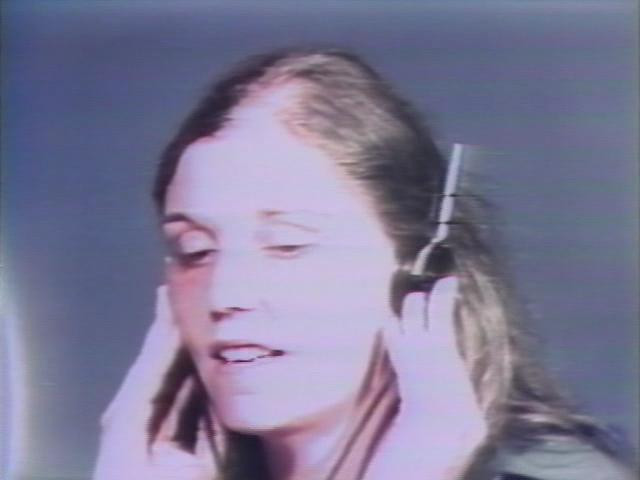
“Boomerang”, Serra’s film featuring artist Nancy Holt, was made in 1974 (fig 3). Holt wears a pair of studio headphones and ad-libs, while her own voice is recorded and played back to her with a slight delay. The result is disorientating and confusing on one hand, but endearing and emotive on the other: at one point Holt stumbles over the word “boomeranging” as it re-emerges into her ear before she has stopped saying it: “Boomeranganganging”. She repeats the word twice, smiling: playfully making the most of the audio effect.
It is difficult to ascertain the circumstances behind the making of this film. In the background, if you listen carefully, there are other voices, noises-off, other things going on at the same time. There are drop-outs in the tape here and there: where a previous recording (possibly?) can be heard. At one point the tape needs to be changed and the effects stop; but the video continues. The whole is disjointed and a bit jarring in places: at the end I would say that Holt, even, gets a bit bored with the process, she runs out of things to say. The whole thing seems experimental, but in a rather more “contrived” way than the less-contrived “Hand Catching Lead”. It feels forced, agitated; and while this is most likely an intention it nevertheless makes for an uncomfortable experience.
Fig 4 Nancy Holt in Richard Serra’s “Boomerang” 1974. From moma.org used for educational purposes.
Holt’s double-voice is as much an intruder into space-time as the presence of Serra’s sculptural work. The “materiality” of her voice is emphasised by its repetition- and we are engaged not just with the sound of it, but also with Nancy herself. We briefly hear Holt’s normal voice; when the tape drops out and it is somehow a vunerable, soft thing; compared to the electronic harshness of the looped sound. It seems, as Michael Rush points out, a comment on the intrusion and prevalence of the recorded voice in twentieth century life (1999, p 86).
Rush also points out that Serra was not a video artist, but rather, an artist who dabbled in video (1999, p104). The videos have an experimental feel, using friends (Grass and Holt) as dabbler-collaborators. I would say that these films were made, literally, in the process of making other things: by-products of Process Art. Serra’s intention of studying his own sentiments and experiences through art echo in these short films.
Bibliography
Foster, H et al (2011) Art Since 1900Thames & Hudson, London
Does institutional critique presuppose an “insider” audience requiring familiarity with artworld topics and issues or can it be understood by almost anyone spending an hour or two in a gallery?
As our manual informs us (page 129), works produced from the genre of Institutional Critique address the institution of which they are a part. They are, by their very nature, site-specific, although site-specific works are not necessarily from the genre of Institutional Critique. Their purpose is to hold a mirror to The Establishment, to criticise it from within: of course this means that The Establishment is criticising itself, but that kind of irony is an exciting thing, it becomes like a hall of mirrors, reflecting on reflections and causing a hint of anarchic mayhem. Institutions are, these days, positively encouraged to criticise themselves: there is a new atmosphere of encouraged whistle-blowing and I see no reason why the Art World should not be a part of this.
Often, the critiques are self-evident and obvious to anyone interested enough to visit a gallery in which the pieces are displayed. I would cite Rose Finn-Kelcey’s “Bureau de Change” as an example of this.
Rose Finn-Kelcey’s “Bureau de Change” 1988. From Putnam 2001 p 91
“Bureau de Change” was made after Van Gogh’s “Sunflowers” was sold to a Japanese insurance company for a record auction price: nearly $40 million. Putnam (2001, p90) comments that “her careful arrangement of gold, silver and copper coloured coins represented a transformation from oil paint to money. A specially constructed viewing platform allowed visitors to look down on the work in its entirety, and the presence of a uniformed guard, as part of the installation, emphasized the idea of art in terms of monetary value”. The title refers to the exchange of goods into monetary value: and the shifting meaning of things: that are only as valuable as “the market” says they are. To mirror Van Gogh’s habit of painting several versions of things, there were several versions of “Bureau de Change”: there was an “international version”, made with sterling, dollars and yen, and also an Irish version in 2003, which Tate states was made with “Irish” currency, presumably Euro.
Viewing a lovely shiny arrangement of sunflowers from a platform would be a pleasurable experience for somebody unfamiliar with Van Gogh. I would hazard though, that everybody would recognize that iconic image, and it wouldn’t be a huge intellectual leap to put two and two together with this one, to extract its meaning, especially if there was some accompanying “Blurb” on the wall. The same would go for Fred Wilson’s Maryland project which was the focus of assignment four, in which Wilson “Mined” a museum’s stock to contrast exhibits, in order to highlight the racial inequalities of display. I really don’t think that a visitor to the Maryland Historical Society’s museum would have needed “familiarity with art-world topics”, to grasp why a Ku Klux Klan hood was being displayed in a posh perambulator, which in turn was displayed next to photographs of black nannies wheeling similar prams.
Part of Fred Wilson’s “Mining the Museum”- a Ku Klux Klan hood displayed in a pram: the type that black nannies would have pushed in Maryland. From Putnam 2001, p168.
It is natural for professionals to question and improve their practice, and to probe the institutions from which they work at the same time. The art world is, and nor should it be- any different. We have moved away from the slightly scary and inaccessible “white-box” gallery environment and as Putnam states, “One result has been an increasing interest in examining the museum’s part in shaping our view of art and making it accessible”. Thank goodness, this all moves away from the Greebergian, Barr-chart cleverness of the past. And in all honesty, does it matter if it is not understood by all? Art is my passion, classical music is not. This does not mean, however, that I do not enjoy the odd concert.
Biblography
Putnam, J (2001) Art and Artefact, the Museum as Medium Thames & Hudson, London
These are strange times for everyone, and I freely admit that my studies have taken a back seat for a few weeks. I work in the health-care profession and recently I have not had the brain-space to think about my studies; but the dust is settling a little in the sense that I know what I will be doing, and where at least, for the foreseeable future. This means that I will need to allow my brain-cells to catch up a little and to get back into the academic swing of things. It will also act as a good means of distraction in these oddest of times.
One of the main points has been my use of the first person, which I am managing to curtail, certainly in the more formal assignment pieces at least. I do allow it to creep in to the exercises a little, as it represents my personal voice and I think that’s fine, but I have made sure that it is reined in.
I also note that my descriptive responses are sometimes over weighted- unless an exercise requires a comparison or descriptive commentary it is not necessary to give extra weight to this. I like the suggestion of printing off my written pieces and colour-coding them to see where the weighting lies in order to be able to make adjustments. This may also help to avoid “hopping back and forth too much”- a habit which has perhaps emerged from thought-occurences which I want to squeeze in somewhere before I forget them again! I think this occurs mainly in exercises: which I write in a less formal way, but maybe I should in future begin to treat them as academic pieces in their own right.
It is suggested that I use introductions to place myself in an argument more rigorously: specifically in relation to points of view which differ from other voices which I may have brought in to my writing.
I am glad to see that the Barr Chart is referred to as “complex territory”: thank goodness! I will continue to attempt to negotiate this particular minefield with a positive attitude. I am glad to see that my sketchbook responses were positively received.
I have taken on board the comments on the assignment piece (Mining the Museum) and will endeavour to work towards them in writing the final assessment. Under normal circumstances, I may have revisited Mining the Museum to make some changes, but it has been some weeks since I even thought about it (due to my job) so I really feel that now I need to move on and begin the final part of UVC. Originally I had applied for the Summer assessment event but have deferred until the next one. It has been a very stressful few weeks and it still is, but now I am in a position to be able to enjoy my studies again.
Charleston Farmhouse, home of the infamous Bloomsbury Set, opened its new exhibition space in September 2018. Presently it is showing work by Shani Rhys James, who was born in Australia in 1953 and came to the UK when she was 10 years old. The exhibition blurb tells us that “in her portraits, interiors and still-lifes, Shani Rhys James presents an uneasy domestic scene that summons childhood memories and family secrets. Her recent work confronts the fragility of domestic life, aging and ritual, often returning to the drama of the mother and daughter relationship”.
The information also suggests that “The paintings could be seen to echo the relationship between Vanessa Bell and her daughter Angelica Garnett” which seems a little tenuous, but it also quotes Rhys James comments about the art/life connections at Charleston:
The life, art and home of the artists were all part of their painting and creativity. The chairs, the bowls, the plates, the table were all aesthetically chosen and became part of their painting. Art and life were interconnected.
Fig 1 Vanessa Bell View Through a Window at Charleston 1948. My photo
I love visiting Charleston. It unfailingly makes me want to rush home and paint everything in sight, despite my slight misgivings for the characters involved; the claustrophobic Crucible-effect of the farmhouse and the aloof separate-ness of the group versus the-rest-of-the-world. The eagle eyes of the volunteers, (“please hold your bag in front of your body, madam”) and the dim rooms (why did they paint the walls black?) make the new exhibition space in the converted barn a welcome contrast. Half the exhibition space is given up to donated works pertaining to the house and its inhabitants: sketch-books, studies, photographs and finished paintings (fig 1) while the rest of the space houses visiting exhibitions.
Rhys James’s canvases are mostly huge. Given the vast space inside the barn, it is surprising that it was renovated with such low ceilings. There isn’t enough space for the paintings to collaborate with us, the observers; they jostle for space like clashing patterns. The lighting was also terrible: small spot-lights were positioned that illuminated some of the faces: an effect imposed on the work and not of Rhys James’s making. The exhibition space seems designed for smaller works. Oil of Ulay2 (2018) confusingly pre-dates Oil of Ulay (2019) making me wonder if the paintings had been mis-labelled, or if the 2018 painting had its “2” added after the painting of the 2019 work.
Fig 2 Oil of Ulay 2019 oil on canvas
The face of Oil of Ulay had been harshly lit by a spot-light: evident in my photograph. The later painting was more evenly lit. Whether this was intentional or not (surely not) it goes to illustrate the strange lighting: it just seemed amateur-ish, in such a new gallery space.
Fig 3 Oil of Ulay 2 2018 oil on linen
Notwithstanding the strange lighting, Rhys James’s work is spontaneous and quickly, generously executed; paint is splashed, dripped, diluted, scraped and in some places, richly knived-on like butter. The hairbrushes in the “Ulay” paintings are full of texture; you can almost feel them scratching your scalp. Objects are placed in compositions as if they are figures, without shadows sometimes- dreams perhaps, or memories. The woman (the artist’s mother) in Ulay 2 leans forward out of the reddish gloom, puzzled- as if trying to translate or recognize what she sees in the mirror, while the young woman in the Ulay painting of 2019 looks away, not bothering even to look.
Fig 4 Detail of Oil of Ulay (fig 2)Fig 5 Glass of Water 2017 oil on linen
Glass of Water (2017) is a painting of the artist’s mother following a stroke. Rhys James comments (on the picture label) that after the stroke, “she was either trapped in her bed or moved by hoists into a wheel chair” so presumably, that glass of water, in an incongruously stemmed goblet, is out of reach without help. The figure in the bed looks marooned, tiny- she hardly causes the bed-covers to reveal her form.
Fig 6 Blue Top 2013 oil on canvas
Several of the other paintings depict children: looking bemused, as if they have accidentally wandered into the frame (figs 6, 7 and 8) or challenging, almost like ghosts: why are you looking at these flowers, that person, those gourds, when I am here. I wondered if there was something in this, some kind of guilt perhaps, then I read the gallery label for Blue Top (fig 6) in which the artist speaks of her journey to the UK:
I was trying to paint about how I felt leaving Australia and all my family as a child. It was to be for a year, but my mother sold the return ticket and hitched with me around Europe.
Fig 7 Boy and Bouquet 2017 oil on linenFig 8 Two Gourds 2017 oil on linen
The children in the paintings are like after-thoughts, sad looking little things in the background of paintings of lush bouquets and beautiful French earthenware jugs.
Rhys James’s paintings are about loss and confusion, even a gentle sense of neglect. It is a shame that so many large canvases were crammed into the space, the larger canvases particularly needed to be displayed singly. The exhibition was ticketed: perhaps the organizers felt that they needed to justify the entrance fee.
Paik was born in Seoul but lived and worked in Japan (where he studied musicology), Germany (more music, philosophy and art history) and the U.S. Whilst in Germany he met and worked with several avant-garde composers including Karlheinz Stockhausen, who had been working with early audio synthesizers. Paik met George Maciunas in 1961, and joined the Fluxus group in 1962, having his first solo exhibition entitled “Exposition of Music-Electronic Television” in 1963. He moved to America in 1964, collaborating with cellist Charlotte Moorman in works such as Robot Opera, in which a remote control junk-model robot called Robot K-456 accompanied Moorman’s cello-playing with recordings of J. F. Kennedy speeches. Not only did Robot K-456 (fig 1) play recordings, it could also walk, and even urinate. It was an intentionally shoddy humanoid, reflecting “a desire to make technology appear closer to humanity, rather than the product of complex and hidden scientific processes” (exhibition pamphlet).
Fig 1 Paik’s Robot K-456, my photo, February 2020
Televisions, video and the movement and transmission of information was the focus of Paik’s work, and TV screens feature heavily in much of it, in a eccentric mix of sculpture, performance and audience participation. The exhibition at Tate Modern (October 2019-February 2020) reminded me of my early visits to The Science Museum in the 1970s, with moving things, buttons to press, exhibits to not just look at, but to watch. Indeed there were several school parties sharing the exhibition space, which made seeing some of the exhibits tricky: particularly those which involved videoing the observer- an endless stream of selfie-taking on the part of the teenage girls made absorbing any of the information rather difficult.
Fig 2TV Garden 1974-77
With “TV Garden”, Paik presents us with a future where technology is an integral part of nature, with live plants growing around a variety of screens. The monitors could have looked like a fly-tip, but they don’t. They look as if they are growing amongst the plants, like some sort of exotic cactus. And this exhibit was easy to observe: it was presented in a long thin room and you just had to wait your turn, rather like looking at an exhibit in Kew Gardens or The Eden Project. The monitors play one of Paik’s videos, “Global Groove” of 1973, which according to the wall-blurb “mixes high and popular cultures with imagery from traditional and contemporary Western and non-Western sources”, in an eerie prediction of the global connected-ness we all experience today.
Fig 3Uncle, 1986
Paik created three generations of a robot family for the 1986 exhibition “Family of Robot” in Ohio, including grandmother and grandfather, mother and father, aunt and uncle and children. The generations were represented by the technology of the time, so that the grandparents were built from 30’s and 40’s radio cabinets and TV sets while the children were assembled from the latest tech of the 1980’s. These reminded me of that other construction of technology at Tate Modern, Cildo Meireles’ “Babel”, a towering edifice comprising layers of technology: with old valve sets providing the foundation for newer tech as the tower grows in height. Meireles’ piece is not as light-humoured as Paik’s family of robots; Babel‘s radios are all quietly tuned to different stations and chatter inanely to each other ad infinitum, while Paik’s family seems much more benign.
Fig 4One Candle (Candle Projection) 1989
Fig 5One Candle (Candle Projection) 1989
In One Candle (figs 4 & 5) a camera records a single candle flame which is projected multiple times onto the walls. These images are separated into red, blue and yellow light and as visitors pass by, the flame flickers in the draughts and the projected images move. It was rather mesmerising: watching this happen, one couldn’t help but worry that the candle might blow itself out: a comment perhaps, on the precariousness of our existence. The wall-blurb states that “the live candle demonstrates, in real time, the Buddhist belief that all things are interconnected and in a continual process of change”.
This exhibition was a reminder of how inter-connected we all are, and how technology can help extend the human experience rather than hamper it. Interactive and eccentric, it also shows how inclusive art can be, and how un-stuffy it should be. Fluxus was art for the masses, something for everyone to enjoy and participate in: for me, this exhibition was the perfect antidote for all the Rich White Male modernism that I have been studying.
I have chosen a piece by Christian Jankowski called “The Finest Art on Water” which was shown at The Frieze Art Fair in London, 2011.
Charlotte Higgins writes “You see them moored in the lagoon, the yachts: each one conveying their cargo of multimillionaire art collectors to the prosecco-sodden art ritual that is the opening of the Venice Biennale. This June, it was Roman Abramovich’s that dominated: to this unmarine eye, at least, it seemed as vast and unassailable as a Royal Navy frigate” (2011, theguardian.com).
The Finest Art on Water, Christian Jankowski 2011. From theguardian.com for educational purposes
A yacht such as Abramovich’s was displayed at the Frieze Art Fair with a price-tag of €60 million, or €75 million if it was purchased as a piece of artwork as authenticated by Jankowski. If this seems a little rich, there was a smaller motorboat, “on display at the fair, among the Robert Rymans and the Tacita Deans”, on sale as a motor boat for €500,000 or as a work of art, €625,000.
This may seem a little obvious, as an example, but it is very apt. The obvious difference, is money. As Higgins (ibid) comments, the connection between the art-world and extreme wealth, is “queasy-making”. Jankowski made the connection to the wealth of the Vienna art aficionados himself, saying “when you see the yachts lined up at Venice it is an exhibition in itself”. The idea is an extension of Duchamp’s Readymades but with a price tag: he says “I’m interested to see whether some collector has the capacity to push what they do to an extra level” (and to make himself a cool €15 million in the process). Rather petulantly, he adds “American artist Donald Judd was putting chunks of cement in the desert and people were able to appreciate it is art” (ibid).
On one level, this would seem to be the work of a petulant artist, along the lines of Danto’s J Seething in “Works of Art and Mere Real Things” (accessed from pcnw.org) who declared his red rectangle art, and so it was. But there is more at play. Enrico says (at vernissage.tv):
The work of Christian Jankowski is a performance, which engages often unsuspecting collaborators to innocently collude with him, making them ‘co-authors’ of the final result, who often (sometimes inadvertently) participate in the very conceptualisation of the work. The collaborative nature of Jankowski’s practice is paramount, as each participant unwittingly contributes his or her own texture. With Jankowski, there is as much emphasis on the journey as the destination, and the risks and chances inherent in his collaborations ultimately give surprising shape to the final works. The product of a generation that grew up with the ubiquity of film and television, its inherently populist influence is evident throughout Jankowski’s work.
The difference with “The Finest Art on Water”, of course, is that the observer is fully complicit. In buying a yacht as “Art”, he is entering into a collaboration with the artist: almost taking part in the piece as a performance once the boat hits the water. It is intention: that is the difference- if we can put aside the the message behind the piece and its eye-watering price tag: “I intend to sell a boat”, as opposed to “I intend to sell a boat as a piece of art”. If we ask, what has being a piece of art done to that boat, then the argument here is about the vast wealth associated with the contemporary art world.
What would be the significance of reversing the arrows in Barr’s chart?
“Make two columns- one ‘forwards’ the other ‘back’. List as many relevant concepts as you are able to develop the contrast between the two columns”.
I feel as if I am being encouraged to be clever, for the sheer hell of it. I am thinking back to Sokal’s spoof thesis of part three, knowing that I could write something, and somebody who knew nothing of such things would read it, and say, gosh. That’s clever. Big words, and concepts and theories. The instructions make no sense, I don’t want to write about something I don’t understand, other than to say that I don’t understand it.
My frustration with the Barr Chart rumbles on. Why is the only then-living artist, Brancusi, stuck in the middle un-categorised? Should his name not be in a red box? Why is futurism not connected to modern architecture and in turn, why is modern architecture in a black box with nothing connecting it to either abstract art-stream? What do the dotted lines mean- does that mean a sort of implicit influence and if so, why isn’t the line joining Bauhaus and modern architecture a solid one?
My frustrations do not lie with the Barr Chart itself, interestingly, I have just spotted on-line at Christies, a “price realized” entry for one of Alfred Barr’s catalogues. At auction it was estimated that it would reach $300 to $400. It actually went under gavel for $2,500. Such is the value that The Establishment has placed upon this hallowed object. Its importance, then, is clear; I acknowledge that. It is an important piece of material culture, pertaining to a ground-breaking exhibition that literally changed the way art was exhibited. I am struggling with the relevance, let alone the meaning of this exercise, I have literally no idea how to approach it.
Instead in the interim, I have simply removed the arrows completely.
Post Modernism a la Barr
I’m going to leave this here; I’m going around and around in circles trying to find a way forward with this, have hand-written charts and columns, and screwed them all up into missiles for the waste-paper basket. Hopefully, a penny might drop, and I can re-visit this.
Fast forward a few weeks. I have been in touch with my tutor, who has advised that this exercise is simply about looking at Barr’s chart and deciding on which movements are thesis, which are antithesis and which are synthesis. An extension of exercise 4.5 then, about dialectic, in which I looked at Cubism and Dada. Let’s take that entire strand then, and follow the arrows from Neo-impressionism through Cubism, Dada, and Surrealism to end up at the non-geometric branch of Abstract art. I have made a chart of sorts, to pick out relevant concepts.
A brain-stormed chart of significance
The common strand of all of them, is “breaking down” and this is key to Greenberg’s concepts of modernism, that the aim was to keep reducing down unnecessary elements until art could reach its purest state. But not all the “breaking down” was in order to achieve this kind of state of artistic Greenbergian Nirvana; much of it was to shake off irrelevant bits according to the particular art movement. In this sense, Dada was the closest to a pure thesis, or a movement with no precedent: emerging as it did in neutral Switzerland as, I would say, a pure and stand-alone reactionary art-form. That is not to say there were not influences from previous movements: as discussed in exercise 4.5.
Barr’s Chart has always reminded me of a Harris matrix, or the method archaeologists use to chart different deposits at an excavation. Take this quote from our UVC manual, (page 122) which is related to the piece- or column of air- of 1967, called Frameworks:
Such works were produced in part to challenge the critical orthodoxy of modernism, not simply to gaze upon a whimsical thought experiment. The authority of the critic in the art world was an instance of cultural authority per se. So conceptual artists making obscure gestures for the attention of artists and critics were nonetheless making political gestures… By the early 1970s that particular gesture was over and done with and arguably Conceptual Art was the last art movement of modern art. Had Alfred Barr extended his chart beyond ‘Cubism and Abstract Art’ he would have arrived at Conceptual Art as a terminus. Not that there would be no more names and dates to add, merely that the connecting arrows would be absent.
I put the last two sentences in italics, because this is the relevant bit, to a Harris Matrix.
Harris Matrix example, from researchgate.net
The Matrix has no arrows, as it is presented in a chronological order with numbered boxes. A true Harris matrix has more in common with a modern London Tube really, but the point is, there are no arrows, just interconnecting lines to show the relationship between deposits. If then, one considers art movements as deposits of Visual Culture, the Barr chart could be continued, but as a Harris Matrix of names and stylistic variances. There is no longer any distinct thesis/antithesis/synthesis. The point is, of course, that it is very easy to say that Conceptual Art was the terminus of movements, because we are live, in the moment. What we have now, is a series of deposits which have yet to make it into the Harris version of the Barr Chart, because they are still on the surface.




 Understanding Visual Culture with the Open College of the Arts