Does the prospect of artificial intelligence make us doubt the authenticity of human intelligence or is it forever a fake version of human intelligence? Give reasons for both arguments.
The first reference to any kind of artificial intelligence in the media that I could find was a short silent movie from 1917 called “The Clever Dummy”. It featured a tailor’s dummy which is given mechanical arms and legs and acts via remote control, but gets switched for a real human with Obviously Hilarious Consequences (you can watch it on Youtube, a bit fuzzy, but full of vaudeville slapstick). The idea of an “automated man” is much older though: in Homer’s Iliad, (written in about 800BC) Hephaestus creates Golden Handmaidens which can speak and act on command, as well as guard dogs and an enormous Bronze Man designed to protect the island of Crete by lobbing boulders at passing ships.

If The Clever Dummy was slapstick vaudeville, Fritz Lang’s 1927 Metropolis was pure German Expressionism. It features a robotic duplicate of a woman, a Maschinenmensch (literally, machine-human). With its grim dystopian take on a split society, and manufactured duplicate-humans there are clear parallels with Ridley Scott’s 1982 Bladerunner, in which the duplicates are called replicants.

The science fiction writer Isaac Asimov first used the term “robotics” and predicted the rise of a huge robotics industry. His story “Runaround” (1941) centred on the ethics of an artificial intelligence, with its Robotic Laws:
“One, a robot may not injure a human being, or, through inaction, allow a human being to come to harm.” “Right!” “Two,” continued Powell, “a robot must obey the orders given it by human beings except where such orders would conflict with the First Law.” (genius.com).
As far as I can gather, the first modern use of robotics was developed in the 1950s, culminating in the installation of the first industrial robot, “Ultimate”, in an American car factory in 1961. These days the most ultimately useful application is with surgery: robotic arms have been designed that replicate the human movements of a surgeon. The advantages of this are mainly that very delicate procedures can be performed, because the amplitude of the surgeons movements are transduced into micro-movements.
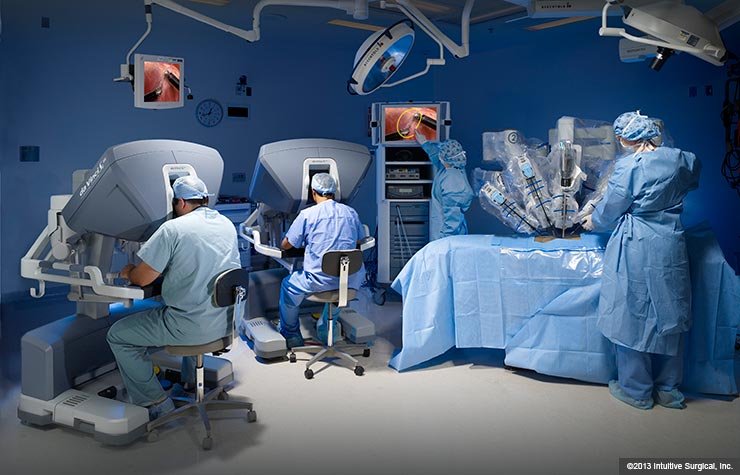
Currently, the real benefits of robotics in healthcare and industry (whether you agree with them or not) are clear. The main arguments against them, as far as I can see, is that they negate the need for a human presence which loses people their jobs. Nor am I sure what I’d think if I knew my surgery had been performed with robotic assistance. The key of course is the word assistance. Presently, as far as I can make out, most robots are still programmable objects: they only operate because a human tells them how to. This is fine, in my book. I have never come across a robot that acts purely by itself, although I am aware of various- lets call them “on-line presences”; which is why we have to click on all those little boxes with traffic lights or cars in them, to prove that we are not robots. I don’t quite understand all that. It doesn’t worry me though, although I am led to believe that it should. In no way though, does any of this cause me to doubt the authenticity of human intelligence. Somebody with incredible intelligence invented the surgical robot: is what is missing, the more nebulous concept of common sense?
Science fiction is exactly that: it’s fiction. I think we have to be careful not to scare ourselves. The original 1982 Bladerunner film was set in 2019. None of the events in it have become real, I don’t think: not really. And recently, I watched the sequel, Bladerunner 2049 (mostly, because I fell asleep) which seemed to revolve around the fact that the human race had managed to kill literally all the trees. It takes a bit of common sense to keep grasp of the fact that these kind of dystopian predictions in fiction may not necessarily transpire. Its NOT REAL, folks: even if we are doing a pretty good job of messing up, I think there will be some trees in 2049. This is a great example of the concept of Zeitgeist, or the spirit of the time: like the film Godzilla which harnessed our fear of nuclear war and transmogrified it into a huge sea-monster. I guess what I’m trying to say here, is that films like Bladerunner 49 harness real fears, and make them into fiction that the general public can relate to: it does feel right now like the human race is at the top of a greased slide that we are beginning to slip down, but it isn’t necessarily the case that helplessly unstoppable robots will destroy everything until there is nothing left.
I’m tempted to say that the term artificial intelligence is an oxymoron, because how can any intelligence be artificial? This seems to be akin to a simulacrum; a copy of something that isn’t actually a copy but exists in its own right as the same, but different, or separate. Artificial intelligence, as a simulacrum, shouldn’t make humans doubt their own authenticity, because it is a different thing altogether. If humans create something new, it could never call into question the authenticity of the old. That’s nonsense, isn’t it? If something isn’t authentic, it must be a fake, in the same way that a fake Picasso isn’t authentic. We don’t call that fake Picasso, an “artificial” one.
It seems that the fears surrounding artificial intelligence somehow hijacking our own is related to a general feeling of loss-of-control. The environment, wars and revolutions, even Brexit: we can’t control any of it. Apparently I’ve heard, we are only a few steps away from microscopic robots that have intelligence. Not even artificial intelligence, their own intelligence. This feels very similar to the phrase homegrown terrorist. Oh my goodness! It’s not surprising is it, that we are a little bit nervous of everything.

The question we are being asked to answer refers to the prospect of artificial intelligence. It isn’t clear, if this means the prospect of things that will (or may) happen, or things that are already happening while we sit back and watch. It seems that any fakery is still in the realms of sci-fi. I guess that in fiction, artificial intelligence will always be fake simply because it’s not real. watching Dr Who as a child from behind the sofa caused many a bad dream, and waking from that kind of nightmare to a small child feels very real. In the mind of a child, it IS real. Fear is real. The things causing the fear are often not:
The Doctor reached out and touched The Robot with the toe of one shoe. Before their eyes, it crumbled away in to a sort of rusty brown dust. A gust of wind sent it swirling across the ground, and soon there was nothing left. (Dicks 1975 p 120-1)
Bibliography
Dicks, T (1975) Dr Who and the Giant Robot Target Books, London
Mirzoeff, N (2009) An introduction to Visual Culture Routledge London
“A Clever Dummy”, silent movie from 1917 starring ben Turpin. Viewed 4 December 2019 at https://www.youtube.com/watch?v=VWYjFdclDNM
https://www.aarp.org/health/conditions-treatments/info-12-2013/robotic-surgery-risks-benefits.html accessed 6 December 2019
https://en.wikipedia.org/wiki/File:Metropolisposter.jpeg accessed 2 December 2019
https://genius.com/Isaac-asimov-runaround-annotated accessed 4 December 2019
https://www.greekmythology.com/Olympians/Hephaestus/hephaestus.html accessed 4 December 2019.
 Understanding Visual Culture with the Open College of the Arts

